From Noise to Narrative: Turning Themes into Actionable Investment Signals with Dynamic Topic Modeling

Macro Insights
QuantCube’s latest insights into thematic investing using large language models
Summary
Thematic investing has become a central pillar of global asset allocation. From artificial intelligence (AI) to the energy transition, from inflation to geopolitics, markets increasingly move on narratives before they move on data. The challenge for investors today is no longer a shortage of themes, but an overabundance of them.
Identifying which narratives are genuinely emerging, which are persistent, and which are little more than noise has become a critical question. The experience of the Metaverse in 2022 is a reminder of how costly it can be to misidentify a theme, or to remain exposed to one after its relevance has faded.
Three questions naturally arise. How can emerging themes be detected early? How can investors distinguish durable narratives from fashionable but fleeting ones? And how can thematic signals be credibly linked to macroeconomic dynamics or an investable universe?
To address these challenges, we have developed a dynamic topic modeling framework that transforms unstructured textual information into structured, time-varying macro and market indicators.
From Text to Time Series: A New Way to Measure Themes
At the core of our approach lies the use of large language models (LLMs) in an unsupervised setting. This design choice is deliberate. Supervised methods risk anchoring analysis to predefined taxonomies and prevailing narratives, limiting their ability to detect genuine novelty. By contrast, unsupervised extraction allows new themes to surface organically, as they emerge in real-world discourse.
The methodology unfolds in three key steps. First, an LLM is used to extract entities from large volumes of unstructured text drawn from curated information sources, including news flow, corporate communications, policy statements, and other qualified textual streams. These entities span a wide range of categories: concepts, events, technologies, companies, sectors, organisations, and individuals.
Second, these entities are clustered – again using an unsupervised LLM – to identify relationships and connections between them. This step imposes structure on raw text by transforming a collection of disconnected references into a network of linked entities. The importance of each entity within this network is quantified using centrality metrics, which combine the intensity of mentions with the number and strength of connections to other entities. The more central an entity, the more structurally important it is within the evolving global narrative.

Third, the centrality of each entity is transformed into a time series, enabling us to track the emergence, persistence, and decline of themes through time. This dynamic representation allows narratives to be monitored with the same discipline traditionally applied to macroeconomic or market data. Sentiment analysis can be layered onto this framework to enrich interpretation, without overwhelming the underlying signal.
What the Data Reveals: Rotation, Emergence, and Decay
The framework captures thematic rotation at the macro level with a high degree of clarity. Major narratives such as Covid, inflation, Ukraine, the energy crisis, supply chains, and tariffs each display distinct centrality patterns through time, reflecting shifts in the dominant macro conversation (Exhibit 2). These rotations often precede changes in traditional macro indicators, making thematic centrality a powerful complement to conventional data in guiding asset allocation and risk positioning.

Beyond rotation, the framework allows cycles of emergence and persistence to be observed with precision. Over recent years, one theme stands out for its durability and structural depth: artificial intelligence (AI). AI exhibits not only rising centrality, but also an expanding network of connections across sectors, technologies, and macro domains – characteristics of a genuinely structural investment theme rather than a cyclical narrative.
At the same time, the framework enables close monitoring of next-wave or discretionary themes, including cybersecurity, digital payments, and quantum computing as Exhibit 3 illustrates. While their current centrality remains well below that of AI, it is comparable to where AI itself stood nearly a decade ago. This positioning highlights their potential to evolve into more dominant narratives, provided connectivity and persistence continue to strengthen.

Conversely, the Metaverse provides a textbook example of thematic decay. Its centrality surged rapidly in 2021-22 but lacked durable connections to broader macroeconomic or technological entities. This structural fragility was visible well before market enthusiasm peaked, underscoring the value of centrality metrics in distinguishing persistent narratives from transient hype.
Linking Themes to Markets and the Real Economy
A key strength of the technology is its ability to map themes directly to companies and sectors. For example, General Motors has become increasingly associated with themes such as electric vehicles, batteries, autonomous vehicles (Exhibit 4), while its exposure to the more generic “vehicles” theme has declined. At the same time, episodic links to “Strikes” and “Sales” reflect cyclical pressures alongside longer-term structural shifts.

Conversely, the framework makes it possible to identify which companies are most exposed to a given theme. Focusing on the “tariffs” entity, firms in the automotive, manufacturing, and retail sectors unsurprisingly rank among the most affected as Exhibit 5 illustrates. More importantly, the rise in tariffs’ centrality since early 2025 has been accompanied by a broadening of connections across industries, reflecting the cumulative impact of successive US tariff announcements spanning multiple sectors.

From Narratives to Market Signals
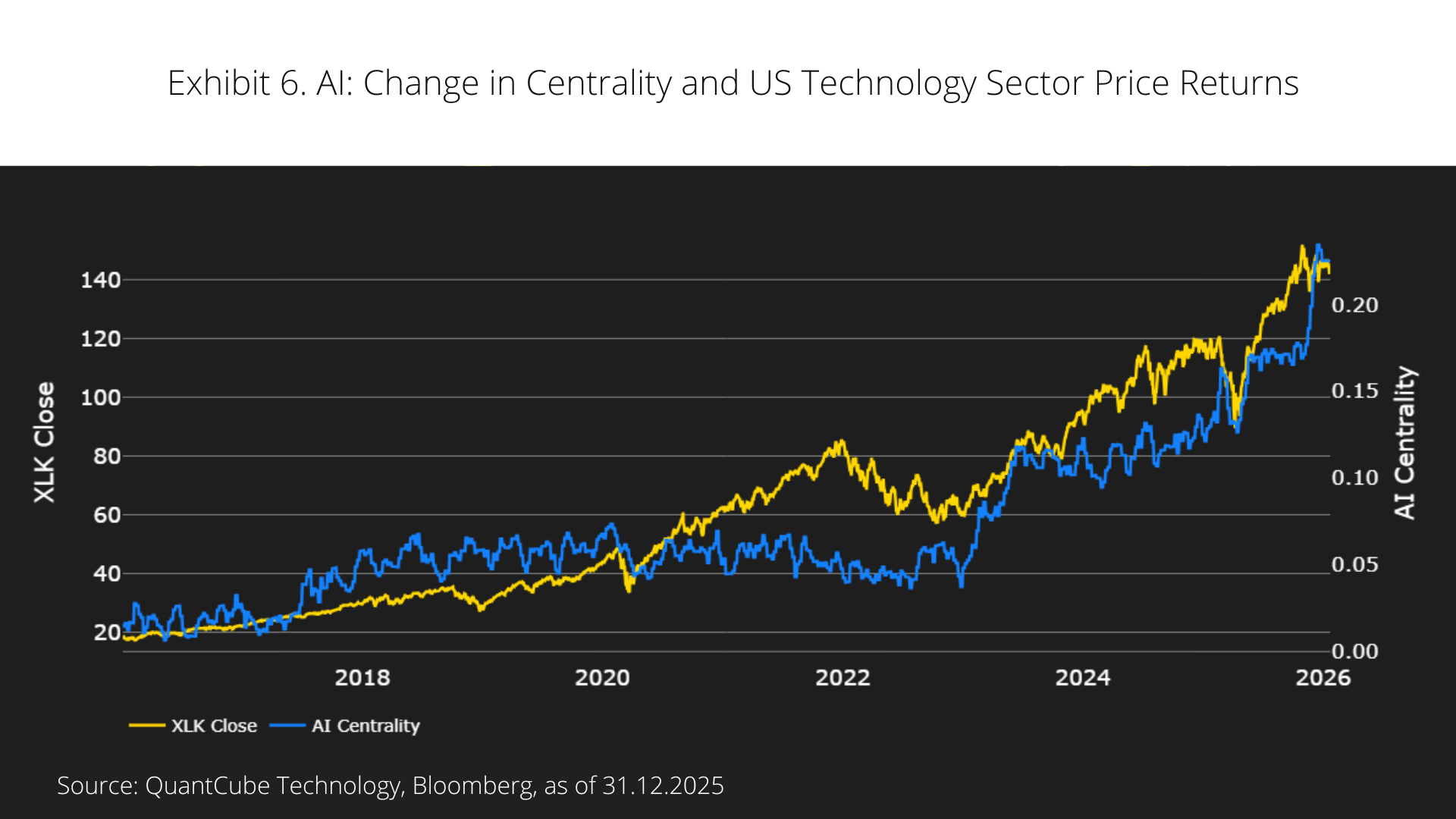
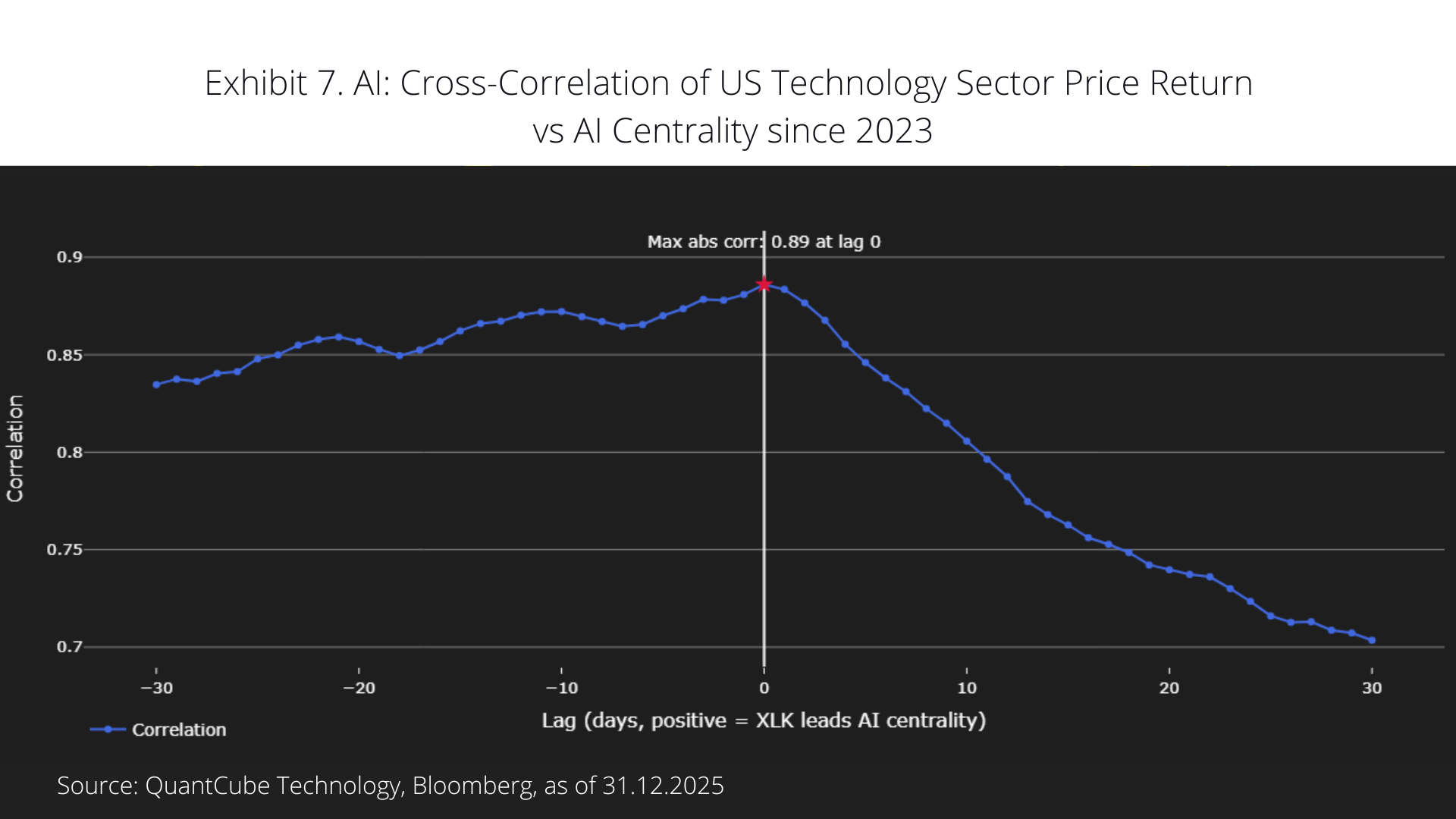
Thematic centrality also exhibits meaningful interaction with market prices. One striking example is the relationship between the AI theme and the performance of the US technology sector (Exhibit 6 and 7). Since 2023, following the emergence of OpenAI and ChatGPT, AI centrality has shown a correlation close to 0.85 with the Technology Select Sector index, in some cases leading returns by roughly 30 days.
While correlation does not imply causation, the timing suggests that thematic momentum can act as an early indicator of sector-level performance, particularly when narratives broaden and deepen across the entity network.
Implications for Macro and Risk Analysis
Beyond equities, dynamic topic modeling offers a powerful lens for global macro analysis. Tracking the centrality of themes such as inflation, growth, financial stability, or geopolitics helps quantify shifts in the macro narrative before they are fully reflected in hard data. The framework also enables real-time monitoring of sentiment around countries, sectors, and individual firms – an increasingly critical dimension of risk in narrative-driven markets.
For investors, the use cases are clear: distinguishing persistent themes from noise, building and monitoring thematic baskets, tracking narrative risk, and supporting both discretionary and systematic strategies. For systematic investors in particular, the framework opens the door to rule-based arbitrage across themes, entities, and time horizons.
Limits – and What Comes Next
Like any data-driven approach, dynamic topic modeling has limitations. Results depend on source coverage, sentiment-price interactions remain complex, and sensitivity varies with the chosen time window. Smaller or niche entities may also suffer from limited sentiment granularity.
These constraints shape the development roadmap. Improving explainability, refining relationship metrics, visualising sub-graphs, and enhancing early detection of emerging themes – particularly through slope and acceleration measures – are active areas of research.
Dynamic topic modeling is not a replacement for macro analysis. It is a new signal layer, designed for a market environment increasingly driven by narratives. We believe it represents a powerful step forward in turning noise into structure – and structure into insight.