
Macro Insights
QuantCube’s Swedish Inflation Nowcast for an early view of inflation trends
Summary
On 4 November, the Riksbank raised its policy rate to 2%, its first increase since 2023, despite the reference inflation metric (KPIF) standing at just 1.5% in September. The apparent contradiction stems from a measurement issue and highlights the need for investors to track the drivers of inflationary forces to monitor monetary policy.
Temporary fiscal measures, including a food-tax cut and lower public transport prices, have been holding headline inflation down. Without these measures, KPIF would have reached approximately 3%, helping explain the Riksbank’s decision to tighten monetary policy.
For investors, understanding which inflation measures drive the Riksbank’s decisions - and how they compare with its official forecasts – is critical to anticipating changes in monetary policy and market expectations.
To address this challenge, QuantCube is introducing its Swedish Inflation Nowcast, expanding its European CPI indicator suite. Updated daily, the new indicator provides an early view of Swedish inflation trends, helping investors assess the Riksbank’s policy outlook and identify potential opportunities in Swedish rates and FX markets.
Understanding Swedish Inflation: Why the Measures Matter
Sweden is a small, export-oriented economy, with the krona particularly sensitive to global risk sentiment and the European industrial cycle. Monetary policy also feeds through to households relatively directly, as most Swedish mortgages carry variable rates and so remain tied to short-term interest rates over the life of the loan.
This makes the choice of inflation measure particularly important.
Unlike headline KPI, which is directly affected by changes in mortgage rate, the Riksbank targets KPIF, the consumer price index at a fixed mortgage rate. It also closely monitors KPIF excluding energy (KPIF-XE) to assess underlying inflationary pressures.
For investors, monitoring all three measures provides a more complete picture of inflation dynamics and their implications for monetary policy.
Introducing QuantCube’s Swedish Inflation Nowcast
Building on the framework introduced in our May newsletter (A New Inflation Wave: Nowcasting and Systematic Strategies as a Macro Edge), QuantCube’s new Swedish indicator provides daily, point-in-time estimates of inflation, using alternative data to capture price developments ahead of official releases. Each observation reflects where inflation stands that day, not a forecast of the monthly release, and each component is modelled individually, so its contribution to the headline is explicit.
Our indicators cover three key measures:
KPIF: The Riksbank’s primary inflation target
KPIF-XE: Underlying inflation excluding energy, helping distinguish persistent price pressures from energy-driven volatility
KPI: Headline inflation, relevant to market instruments such as Swedish inflation swaps
Each nowcast includes a breakdown of energy and non-energy inflation, together with individual component contributions aligned with the revised COICOP classification.
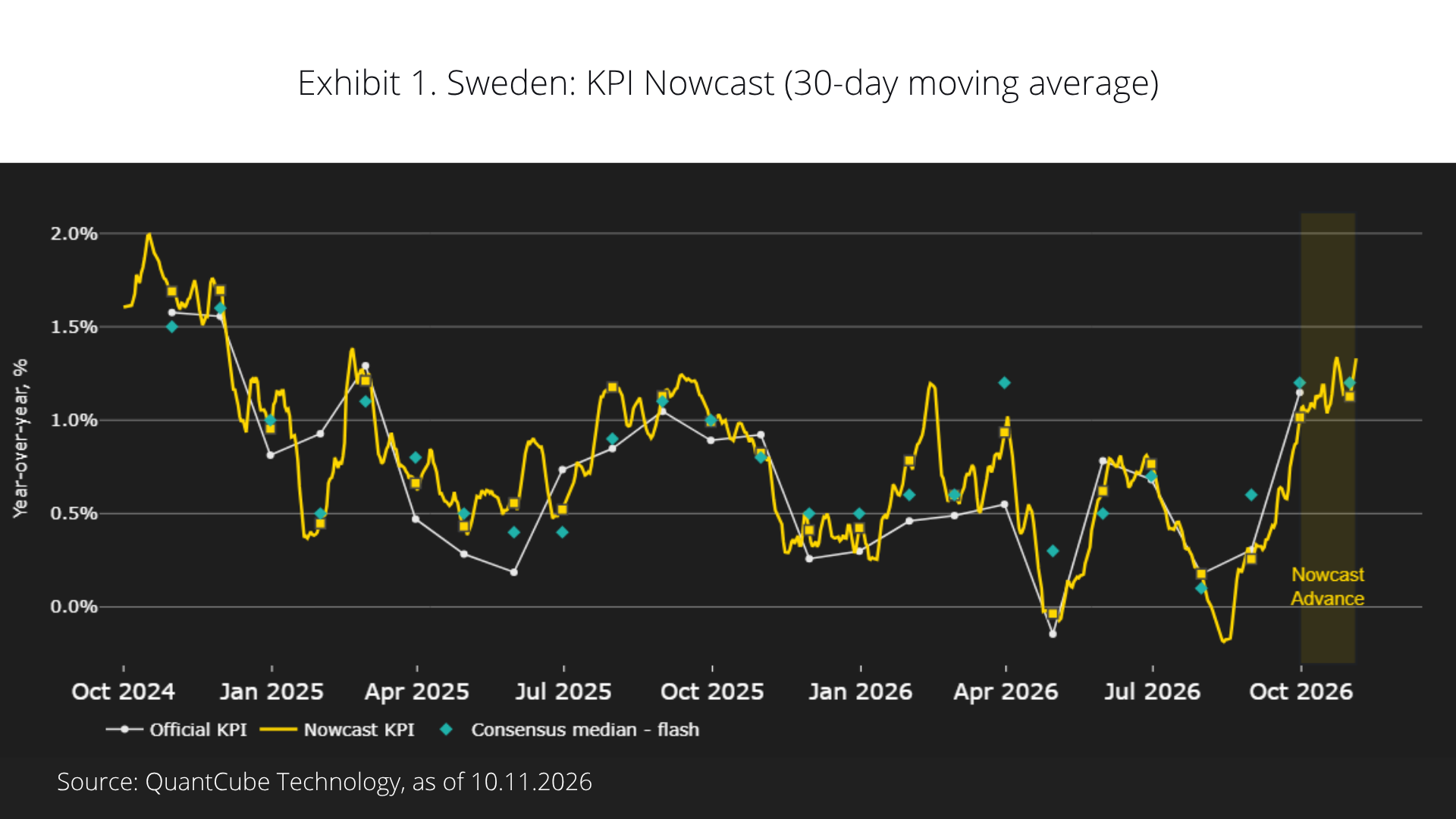
The initial performance tests are encouraging. Since January 2025, QuantCube’s KPI Nowcast has achieved an average absolute error of approximately 0.18 percentage points, outperforming consensus estimates in eleven cases and matching them in a further five (Exhibit 1).
Reading the Riksbank: Anticipating Changes in Its Inflation Outlook
One of the most valuable applications of the Swedish Inflation Nowcast is its ability to identify divergences between current inflation trends and the Riksbank’s official forecasts produced on a quarterly basis, potentially signalling changes in monetary policy expectations before they are reflected in the market.
The September policy decision provides an example.
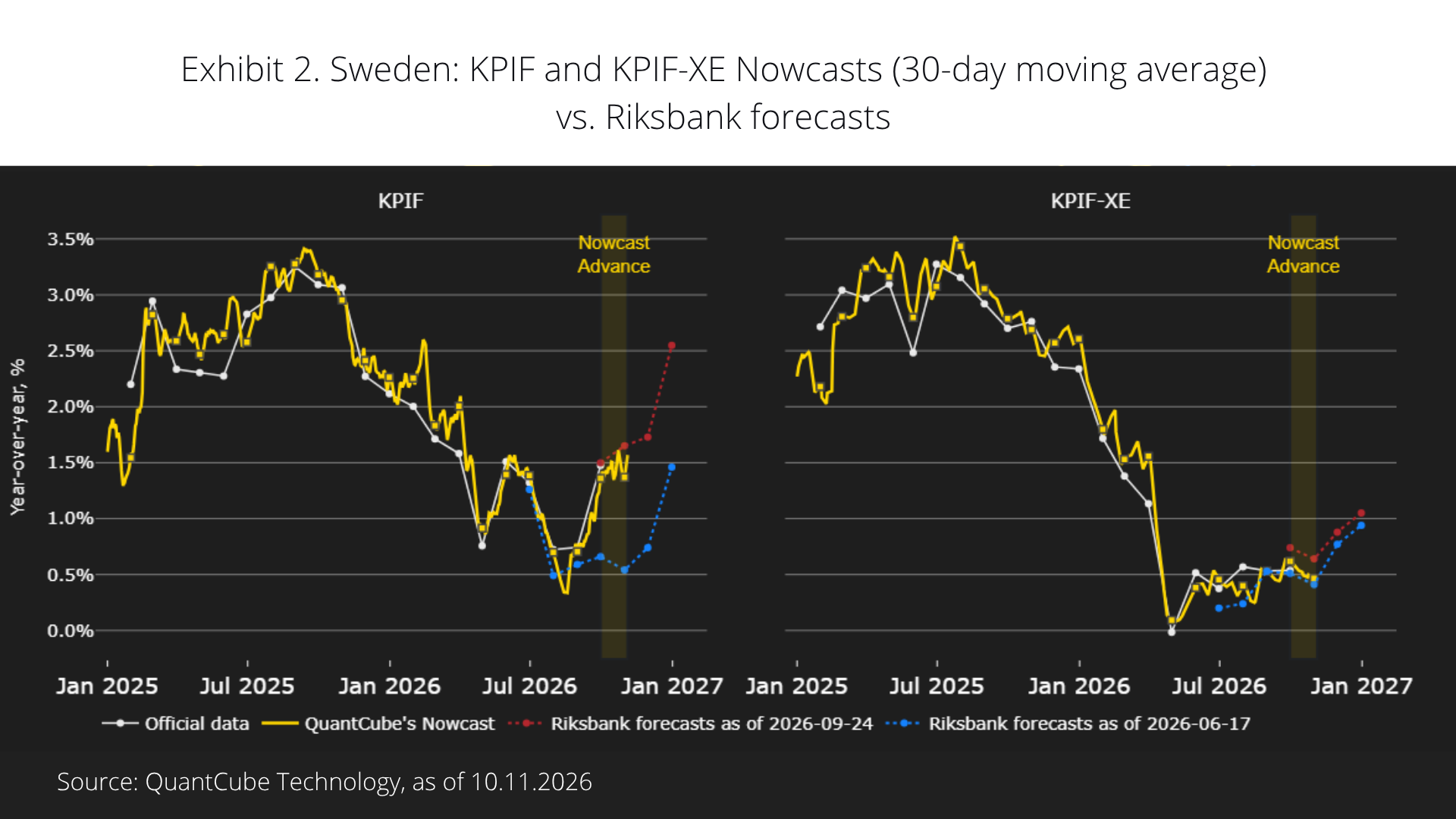
In the two weeks preceding the Riksbank’s 24 September decision, QuantCube’s KPIF Nowcast rose from 0.8% to 1.1%, well above the Riksbank’s June forecast of 0.7% for September (Exhibit 2). The central bank subsequently revised its forecast upwards to 1.5%, consistent with the direction signalled earlier by our nowcast. The breakdown also revealed what was driving the revision. While the KPIF forecast increased by 0.8 percentage points, the underlying KPIF-XE forecast rose by just 0.2 percentage points, indicating that energy was the main contributor.
Today, the signal points in the opposite direction.
For October, our KPIF Nowcast stands at 1.4%, below the Riksbank’s September forecast of 1.7%. The 5 November flash estimate was lower still, at 1.1%. This suggests that the balance of risks ahead of the Riksbank’s 16 December monetary policy report may be tilted towards a downward revision to its inflation outlook.
For investors, the ability to track these divergences daily offers a valuable perspective on the likely direction of monetary policy expectations, rather than waiting for official inflation releases or revised central bank forecasts.
From Inflation Signals to Investment Opportunities
Beyond monitoring the Riksbank, QuantCube’s Swedish Inflation Nowcast offers potential applications in short-term interest rate markets.
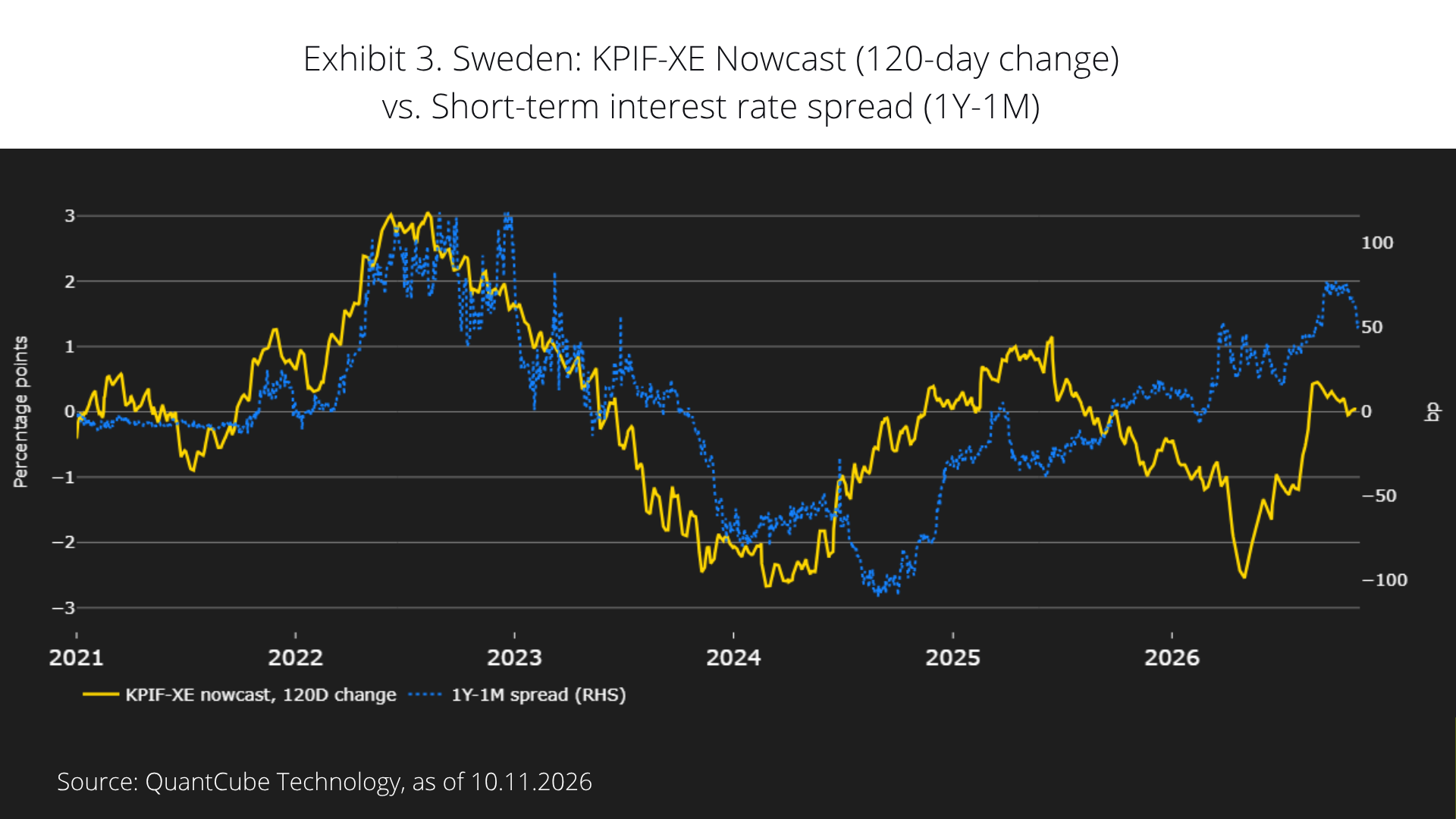
Swedish short-term rates are sensitive to inflation surprises, particularly around Statistics Sweden’s flash releases. Over the past twelve flash announcements, the spread between one-year and one-month interest rates moved by an average of 4.7 basis points, compared with 2.6 basis points on a typical trading day.
More importantly, the direction of the inflation surprises indicated by QuantCube’s nowcast approximately six days ahead of the release matched the subsequent direction of the spread movement in ten out of twelve cases.
While the sample remains small, these initial findings suggest that the nowcast could provide an early signal for positioning in Swedish short-term interest rates.
Exhibit 3 illustrates the relationship between changes in QuantCube’s underlying inflation nowcast and movements in the short-term interest rate curve.
Looking Ahead: Expanding European Inflation Intelligence
The launch of the Swedish Inflation Nowcast marks another step in QuantCube’s expansion of its European inflation indicator suite.
Our next focus is to translate these early findings into actionable strategies for both discretionary and systematic investors, particularly across Swedish rates and FX markets.
In parallel, we will continue refining our existing European inflation nowcasts and expanding coverage to additional economies, providing investors with a broader, consistent framework for monitoring inflation trends, anticipating central bank decisions and identifying market opportunities.
Disclaimer
This website is provided for general informational purposes only and does not purport to be comprehensive or include any representation, warranty, assurance or undertaking. Nothing herein is intended to be advisory or relied upon, nor shall any statement bind QuantCube, its affiliates or successors.
Information provided has not been independently verified and does not constitute an offer or invitation to partake in any transaction, or any sale, purchase or recommendation of any securities or other product or service. Any information contained herein may only be used for your internal use, may not be reproduced or redisseminated in any form, and may not be used as a basis for any financial instruments, products or indices. Nothing herein is intended to provide tax, legal, or investment advice.
This website is provided on an "as is" basis and the recipient assumes the entire risk of any use made of any information contained herein. Historical data and analysis should not be taken as an indication or guarantee of any future performance, forecast or prediction. Market and economic views are subject to change at any time and there can be no assurance that countries, markets or sectors will perform as expected.
Investment involves risks, including market, political, liquidity and currency risks. In no event shall QuantCube or any person involved in the production of this website have any liability whatsoever for any direct, indirect, special, incidental, punitive or consequential damages in relation to the adequacy, accuracy, completeness or reasonableness of this website.