Reading the Swiss National Bank: A New Nowcast for Swiss Inflation

Macro Insights
QuantCube's new Swiss Inflation Nowcast to anticipate SNB policy shifts
Summary
Switzerland occupies an unusual position in the global economy. The Swiss franc is both a domestic currency and one of the world’s principal safe-haven assets, often moving more with global risk sentiment than domestic fundamentals. At the same time, the Swiss National Bank (SNB) relies not only on interest rates but also on foreign exchange interventions to maintain price stability.
These characteristics make Swiss inflation unusually sensitive to external developments, particularly exchange-rate movements and imported price shocks. As a result, understanding the composition of inflation is often as important as tracking the headline rate itself. Monitoring Swiss CPI in real time therefore provides valuable insight into both the inflation outlook and the likely direction of SNB policy.
Methodology: The Same Foundations
Our Swiss inflation indicator follows the same methodology as our broader inflation nowcasting framework described in our May newsletter (A New Inflation Wave: Nowcasting and Systematic Strategies as a Macro Edge). Estimates are produced daily and are point-in-time measurements, meaning each observation reflects where inflation stands on that specific day rather than forecasting the monthly release.
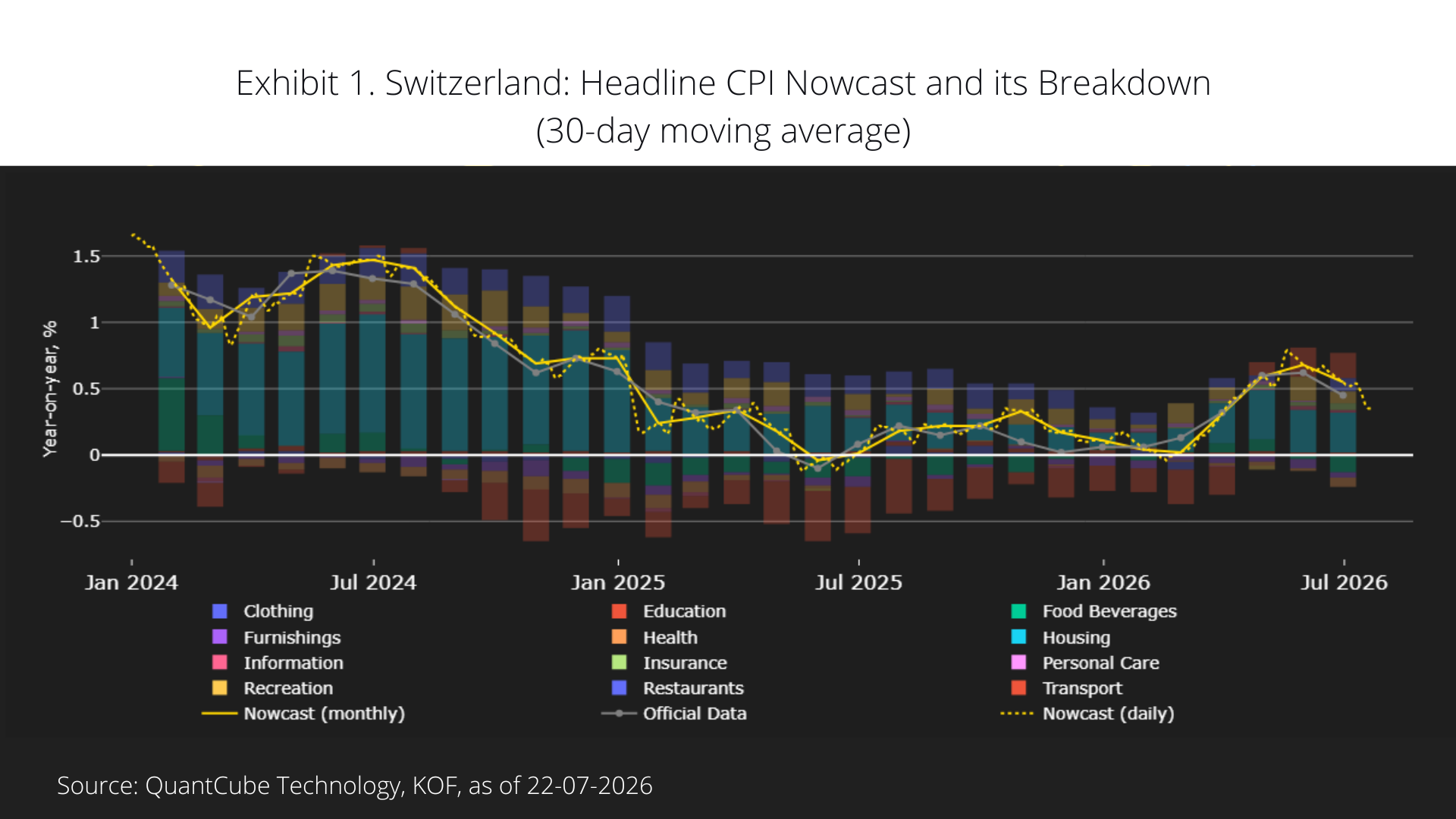
The model combines alternative data with statistical and machine learning techniques while remaining grounded in an economically interpretable framework. Each CPI component is modelled individually, allowing its contribution to headline inflation to be explicitly identified. Alongside the headline estimate, we provide detailed component-level contributions, as illustrated in Exhibit 1.
Domestic and Imported Inflation: Why the Split Matters
For Switzerland, we extended the framework further by modelling domestic and imported inflation separately – two measures that play a central role in the SNB’s policy assessments.
The SNB publishes a conditional inflation forecast each quarter over a three-year horizon, assuming the policy rate remains unchanged. This conditional forecast is the cornerstone of its communication strategy. When projected inflation deviates from the SNB’s objective of remaining positive and below 2%, markets interpret it as an indication that policy will eventually need to adjust.
Importantly, however, the SNB does not respond mechanically to every inflation shock. Temporary increases in imported inflation – driven, for example, by higher energy prices or a weaker franc – are unlikely to trigger an immediate policy response. Instead, policymakers focus on whether these shocks begin to feed into domestically generated inflation, making the distinction between the two particularly important.
Imported inflation influences the SNB’s reaction function primarily through two channels. The first is energy prices, reflecting Switzerland’s dependence on imported energy. The second is the exchange rate. Because the Swiss franc frequently appreciates or depreciates in response to global risk sentiment rather than domestic economic conditions, exchange-rate movements can have a rapid and significant impact on imported inflation and, ultimately, headline CPI.
Our daily decomposition (Exhibit 2) allows investors to monitor these two inflation dynamics separately, providing an earlier indication of whether price pressures are likely to remain transitory or become sufficiently broad-based to alter the policy outlook.

Investment Applications
For investors, the nowcast provides value beyond anticipating the next CPI release. Combined with the domestic/imported decomposition, it offers a real-time framework for interpreting SNB policy, currency intervention risk, and inflation surprises.
The first application is positioning around SNB policy decisions. Updated daily, the nowcast allows investors to compare the evolving inflation trajectory with the SNB's latest published conditional forecast well before the next quarterly policy assessment and ahead of the official inflation release. Exhibit 3 illustrates this. Our nowcast remained above the SNB’s March 2026 conditional inflation path for several weeks ahead of the June meeting, anticipating the direction of the SNB’s subsequent revision. When the June assessment was published, the SNB materially raised its inflation forecast, validating the signal. Today, the opposite picture is emerging: the nowcast is tracking below the June conditional path, suggesting the balance of risks ahead of the September assessment may now be skewed towards a downward revision.
The decomposition provides an additional layer of insight. A divergence driven primarily by imported inflation may not require a policy response, whereas a simultaneous divergence in both domestic and imported inflation would provide a stronger indication that the SNB may need to adjust its policy stance.

The second application is foreign exchange positioning. Because the SNB often manages imported inflation through exchange-rate policy, the persistent deviations in imported inflation can provide an early indication that intervention pressure may be building in EUR/CHF or USD/CHF, days before markets begin to price it.
The third application is trading around official CPI releases. Swiss CPI is published with a delay of several days, while the nowcast updates daily. Beyond providing an advance indication of the headline outcome, the domestic/imported decomposition helps investors interpret the nature of any surprise. An upside surprise driven by imported inflation is likely to have different policy implications – and therefore different trading consequences – than one generated by persistent domestic inflation.
For systematic investors, the high-frequency signal can also support quantitative strategies. We have developed a USD/CHF carry strategy based on the spread between our US and Swiss inflation nowcasts. In out-of-sample testing since 2022, the strategy has generated annualised returns of 9% with a Sharpe ratio of 1.20.
Next Steps
Our work now focuses on two areas. First, we are formalising systematic trading signals derived from the nowcast and its decomposition to support discretionary investment decisions across Swiss fixed income, foreign exchange, and rates markets. Second, we are extending the same inflation nowcasting framework to additional European economies, broadening out real-time coverage of regional inflation dynamics.
Disclaimer
This website is provided for general informational purposes only and does not purport to be comprehensive or include any representation, warranty, assurance or undertaking. Nothing herein is intended to be advisory or relied upon, nor shall any statement bind QuantCube, its affiliates or successors.
Information provided has not been independently verified and does not constitute an offer or invitation to partake in any transaction, or any sale, purchase or recommendation of any securities or other product or service. Any information contained herein may only be used for your internal use, may not be reproduced or redisseminated in any form, and may not be used as a basis for any financial instruments, products or indices. Nothing herein is intended to provide tax, legal, or investment advice.
This website is provided on an "as is" basis and the recipient assumes the entire risk of any use made of any information contained herein. Historical data and analysis should not be taken as an indication or guarantee of any future performance, forecast or prediction. Market and economic views are subject to change at any time and there can be no assurance that countries, markets or sectors will perform as expected.
Investment involves risks, including market, political, liquidity and currency risks. In no event shall QuantCube or any person involved in the production of this website have any liability whatsoever for any direct, indirect, special, incidental, punitive or consequential damages in relation to the adequacy, accuracy, completeness or reasonableness of this website.